News
Site news
A new in vivo study reports promising results for a 3D-printed bone scaffold that hardens after implantation. This innovation could reshape orthopedic surgery by enabling custom, mechanically tunable implants that support natural bone regeneration.

Several researchers of the BAMBBI team actively participated in the SEMIT 2025 Congress, held on October 2-3, 2025, in Barcelona.

Dr. Renan Nunes, Postdoctoral Researcher in the BioNanos&Metals group at the Federal University of ABC (Brazil), has joined BAMBBI for a year as a Visiting Researcher, in order work in the functionalization of 3D-printed calcium phosphate scaffolds with nitric oxide–releasing materials and other biologically active nanoparticles.

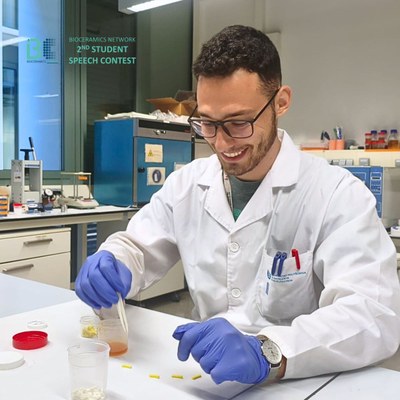
Roberto Fagotto, PhD student of the Biomaterials, Biomechanics and Tissue Engineering (BBT) group at UPC and part of BAMBBI's research team, has achieved second place in the prestigious 2nd Students Speech Contest of the Bioceramics Network.
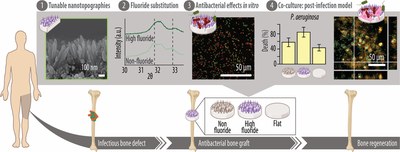
Carla Arca (et al.) has recently published a paper in Bioactive Materials that introduces a a multifunctional calcium phosphate material that helps healthy cells attach to an implant before bacteria can, offering a reliable way to make dental and hip replacements last longer without needing antibiotics.
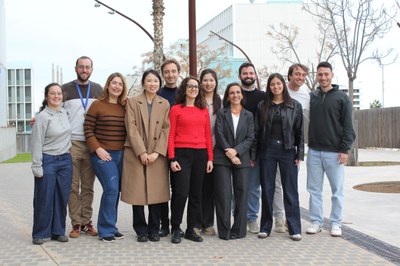
The BAMBBI project researchers have recently participated in the IX BBT Annual Meeting. The day-long event focused on celebrating a year of high productivity, optimizing lab management, and fostering team spirit through the legendary—and highly contested—BBT Trivia Tournament.
BAMBBI PhD student Carla Arca has joined the Louvain Drug Research Institute from the Université Catholique de Louvain in Belgium to study complex biofilms and bacterial interactions on nanostructured surfaces.

Members of BAMBBI have recently published a new study in Nano Today on the design of "smart" bone grafts. By mastering the art of biomineralization-inspired tuning, our researchers have successfully isolated the effects of surface shape from material composition. For the first time, the team compared titanium and calcium phosphate nanostructures, proving that the physical "nanoscape" of an implant can be just as deadly to bacteria as the material itself.

Dr. Matthias Richard, with expertise in microbiology, molecular biology and antibiotic resistance mechanisms, has recently joined BAMBBI as postdoctoral researcher.

Our latest research demonstrates how doping 3D-printed bone grafts with strontium and gallium significantly boosts the body’s ability to regenerate natural tissue in complex fractures.

Share: